1
/
of
8
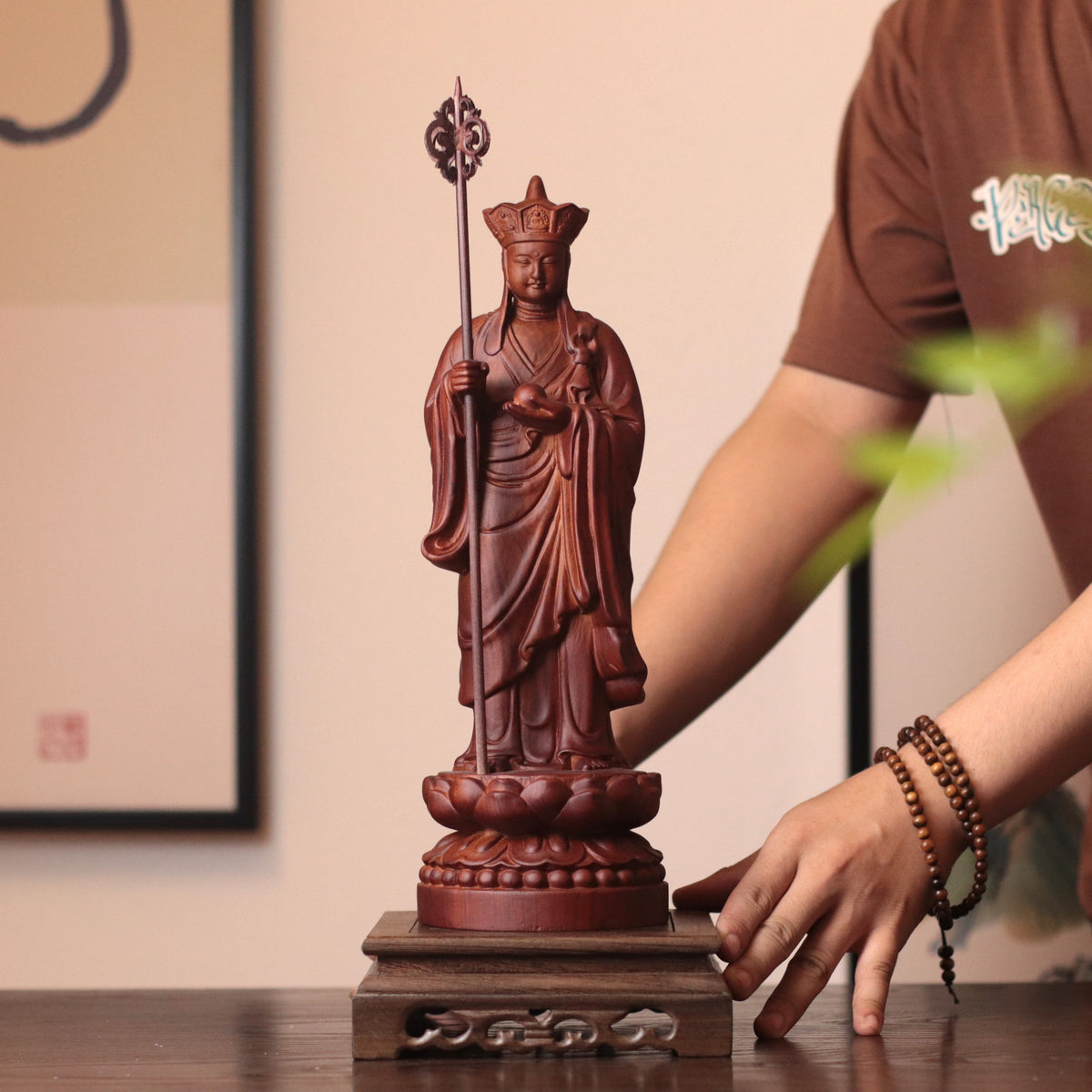
Wooden Standing Ksitigarbha Bodhisattva Statue
★★★★★
★★★★★
4.9 (149 Reviews)
A handcrafted Buddha statue designed to bring peace, balance, and timeless beauty into your home.
- Hand-carved wood look with organic detail
- Calming spiritual decor for any mindful space
- Ideal for living rooms, meditation spaces, or gifting
- Crafted with care by skilled artisans
Regular price
$99.00 USD
Regular price
$123.90 USD
Sale price
$99.00 USD
Taxes included.
Shipping calculated at checkout.
Quantity
Couldn't load pickup availability
Product Description
Product Description
🌿 Meaning & Symbolism
- Among all the Bodhisattvas in the Mahayana tradition, Ksitigarbha — known in Japan as Jizo — made the most human of vows: to remain until every suffering being has found their way through the dark. He does not sit in celestial ease. He stands. He holds his Khakkhara staff — six rings that resonate through the six realms of existence, a sound traditionally understood as a wake-up call for the wandering mind. In his other hand rests the Cintamani, the wish-fulfilling jewel that illuminates even the deepest darkness.
- For those who live in the modern world, these two symbols translate simply: the staff that interrupts the spiral of anxiety. The jewel that reminds you that your own light has never gone out.
- Standing upright on a lotus pedestal, this figure embodies Compassion in Action — not withdrawn into meditation, but present, watchful, ready. A Steady Presence for the quietest corners of your heart.
🌿 The Craft Story & The Wood
- This piece begins as a solid block of African Padauk — one of the hardest and most durable hardwoods available, prized for its deep, warm rosewood-red grain that catches light differently at every hour of the day.
- It is carried to Thường Tín, Hà Nội — a district where woodcarving is not a trade but a family inheritance, passed between hands across generations. Our artisans are not factory workers. They are the carvers who learned from their fathers, who learned from theirs. Every fold of Jizo's robe, every ring on the Khakkhara staff, every millimeter of that quietly smiling face — Jizogao, the expression of deep and unconditional empathy — is the result of a hand chisel held with patience, not a machine set to repeat.
- No two pieces are identical. The grain that runs through the torso of your statue will be its own — a map of the living wood, unrepeatable.
- We define our work by Heirloom Quality: crafted to be held by your grandchildren, who will ask where it came from — and why it still feels like something that has always belonged in the family.
✦ Packaging
Each order is carefully wrapped to ensure it reaches you in perfect condition, ready to be placed on your altar or given as a thoughtful gift.
Dimensions
Dimensions
13.8 in H (35 cm) × 4.7 in W (12 cm)
FAQs
FAQs
❓ Is this statue really carved entirely by hand?
✦ Yes — every cut is made by hand chisel, by family artisans in Thường Tín, Hà Nội, Vietnam. No CNC machines, no molds, no mass production. Each piece bears the mark of the carver's hand, which is why no two statues will have identical grain patterns or surface texture. What may look like slight variation in close-up photos is not a flaw — it is the fingerprint of handwork across generations.
❓ What do the staff and jewel in Jizo's hands mean?
✦ The staff is a Khakkhara — six rings that traditionally represent the six realms of existence. Its sound is understood as a call to wakefulness: an interruption of the mind's habitual loops. The jewel is the Cintamani, the wish-fulfilling gem that illuminates darkness — traditionally symbolizing the inner light that never disappears, even in the worst of circumstances. Together, they make Jizo not just a decorative figure, but a complete symbolic presence: wake up, and remember your own light.
❓ Why does African Padauk wood have such a deep red color?
✦ African Padauk is naturally one of the most richly colored hardwoods in the world — its deep rosewood-red comes entirely from the wood's own pigments, with no staining or treatment. The solid grain structure means the color runs through the entire piece, not just the surface. Over time, with exposure to light and air, the color will deepen and mature — this is the nature of living wood, and a sign that your piece is genuine solid Padauk, not veneer.
❓ Where should I place a large standing Jizo statue?
✦ Most naturally: facing your front door, elevated on a console or altar table — traditionally believed to welcome calm energy and offer quiet protection to the household. A northeast corner of your living room or meditation space works equally well, particularly for those who use the space for prayer, reading, or reflection. The key is elevation and stillness: give this piece a corner it can anchor, and it will hold the room.
❓ Is this a good sympathy or grief support gift?
✦ For many buyers, yes — it is exactly that. Jizo is venerated in Buddhist tradition as the guardian of those who grieve: those who have lost children, loved ones, or parts of themselves they cannot name. A standing figure of this size offers a physical anchor in the room — something that asks nothing, judges nothing, and simply remains. For those who have given this as a sympathy gift, the intention is simple: to leave something that remains — quietly, without asking anything in return"
✦ Yes — every cut is made by hand chisel, by family artisans in Thường Tín, Hà Nội, Vietnam. No CNC machines, no molds, no mass production. Each piece bears the mark of the carver's hand, which is why no two statues will have identical grain patterns or surface texture. What may look like slight variation in close-up photos is not a flaw — it is the fingerprint of handwork across generations.
❓ What do the staff and jewel in Jizo's hands mean?
✦ The staff is a Khakkhara — six rings that traditionally represent the six realms of existence. Its sound is understood as a call to wakefulness: an interruption of the mind's habitual loops. The jewel is the Cintamani, the wish-fulfilling gem that illuminates darkness — traditionally symbolizing the inner light that never disappears, even in the worst of circumstances. Together, they make Jizo not just a decorative figure, but a complete symbolic presence: wake up, and remember your own light.
❓ Why does African Padauk wood have such a deep red color?
✦ African Padauk is naturally one of the most richly colored hardwoods in the world — its deep rosewood-red comes entirely from the wood's own pigments, with no staining or treatment. The solid grain structure means the color runs through the entire piece, not just the surface. Over time, with exposure to light and air, the color will deepen and mature — this is the nature of living wood, and a sign that your piece is genuine solid Padauk, not veneer.
❓ Where should I place a large standing Jizo statue?
✦ Most naturally: facing your front door, elevated on a console or altar table — traditionally believed to welcome calm energy and offer quiet protection to the household. A northeast corner of your living room or meditation space works equally well, particularly for those who use the space for prayer, reading, or reflection. The key is elevation and stillness: give this piece a corner it can anchor, and it will hold the room.
❓ Is this a good sympathy or grief support gift?
✦ For many buyers, yes — it is exactly that. Jizo is venerated in Buddhist tradition as the guardian of those who grieve: those who have lost children, loved ones, or parts of themselves they cannot name. A standing figure of this size offers a physical anchor in the room — something that asks nothing, judges nothing, and simply remains. For those who have given this as a sympathy gift, the intention is simple: to leave something that remains — quietly, without asking anything in return"
Free World Wide Shipping
Free shipping on all orders
30-Day Returns
& Easy Exchanges
Secure Checkout
Safe & encrypted

You May Also Like
Create a Calm, Meaningful Home
Bring home pieces that inspire peace, presence, and beauty—every day. with handcrafted pieces you'll love