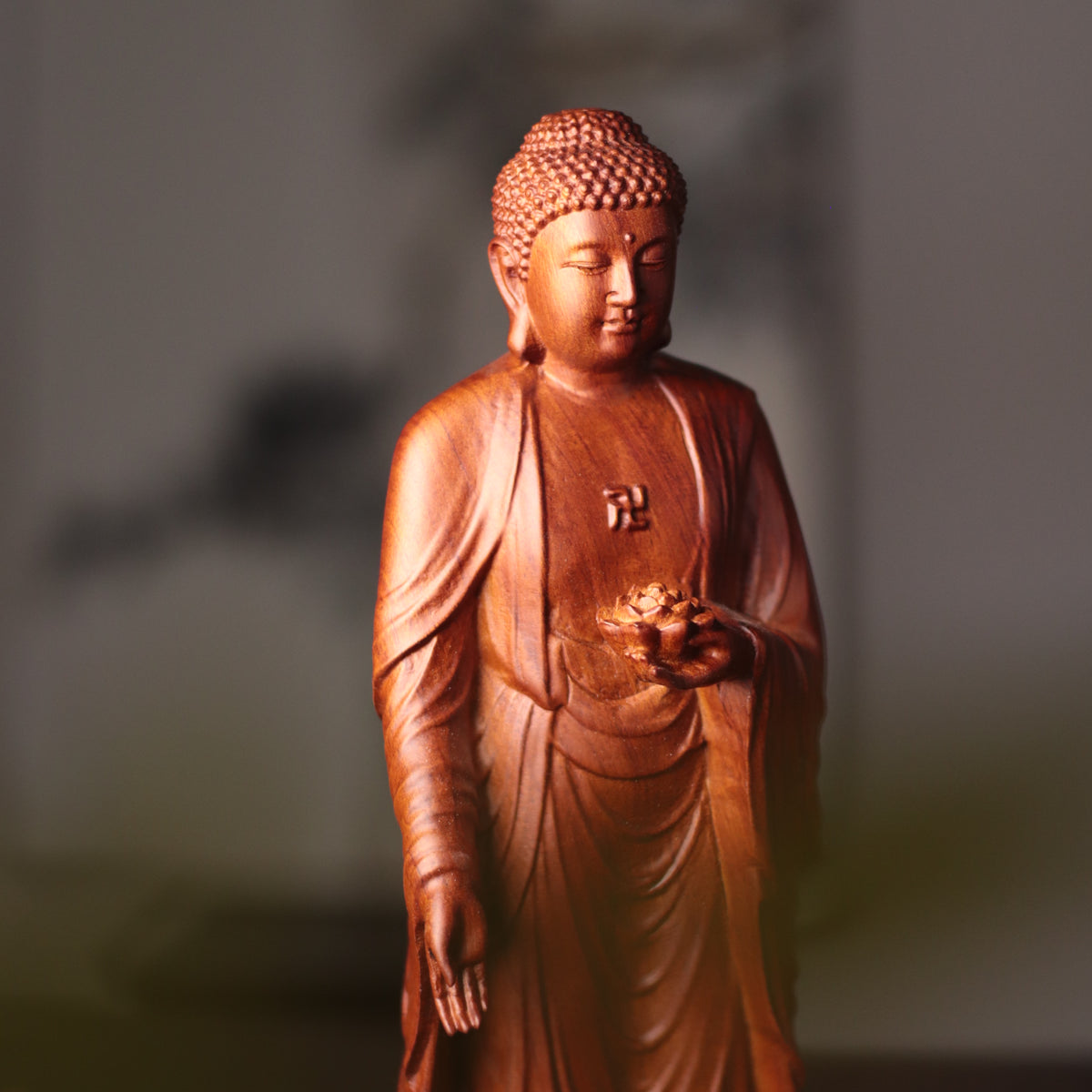
Most standing Buddha statues are still — planted, permanent, waiting. This one is not. This hand-carved Amida Buddha, solid African Padauk, leans gently forward as if caught mid-step, one hand raised with a small lotus bloom resting on the open palm, the other lowered and open toward the ground. It's not a resting pose. It's an arriving one.
🌿 Meaning & Symbolism
The Moment Amida Comes to You
In most Buddhist art, the Buddha waits — seated, eyes closed, the world coming to him. Amida (Amitābha in Sanskrit), the Buddha of Infinite Light of Pure Land Buddhism, is depicted differently in one specific, deeply loved image: standing, leaning slightly forward, in the act of descending to personally welcome a devotee at the moment of death. In Japanese Buddhist art this is called raigō — "the welcoming approach."
The two hands read as one gesture split in half. The right hand raised in Abhaya Mudra — the gesture of fearlessness, traditionally meaning "do not be afraid" — holds a small lotus bloom on the palm, the seat the devotee will be carried on into the Pure Land. The left hand lowers in Varada Mudra, the gesture of granting and generosity, open and offered rather than closed. Together they say what centuries of raigō paintings and statues were made to say at deathbeds across Japan: you are not making this crossing alone, and something is already reaching for you.
For a home, away from any deathbed, the meaning softens but doesn't disappear. It's a statue for the idea that grace moves toward us before we've finished asking for it.
🌿 The Wood & The Craft
Why Padauk for a Standing, Leaning Figure
A forward-leaning standing pose is one of the harder forms to carve in wood — the whole figure's weight has to read as balanced even though the posture is, by design, slightly off-center. African Padauk is dense and dimensionally stable enough to hold that lean indefinitely without the wood shifting or the ankles thinning under stress over time, which is part of why it's chosen over softer, cheaper woods for standing statues this size.
Left in its natural finish, Padauk carries a warm amber-red tone in the grain that will deepen gradually with light and age — the statue is not finished the day it arrives, it keeps developing. Every fold of the robe, the lotus resting in the palm, the lean itself, is cut by hand by family artisans in Thường Tín village outside Hanoi, a wood-carving tradition passed down through generations of the same families. The slight, deliberate imbalance in the pose is the hardest part of the carving to get right — a small asymmetry here is not a flaw, it's the proof the artisan carved the lean freehand rather than working from a symmetrical template.
🌿 Where to Place It
Because the figure leans forward, it reads best where there's a little visual space in front of it to "arrive into" — a hallway console facing into a room, a tall shelf, or a dedicated altar with clear sightlines, rather than tucked into a corner. Keep it on a stable, flat surface set back from the edge, given the forward-weighted stance. Many people place this specific pose on a memorial altar or in a space set aside for a family member who has passed.
🎁 Gifting
For the Passage, Not Just the Person
This pose carries a different kind of gifting weight than a seated meditating Buddha — it's chosen less as a general spiritual gift and more for a specific moment.
- A memorial, death anniversary, or funeral remembrance
- Someone caring for a dying or seriously ill family member
- A dedicated Pure Land or Amida practitioner building out an altar
- A family's first dedicated altar space after a loss